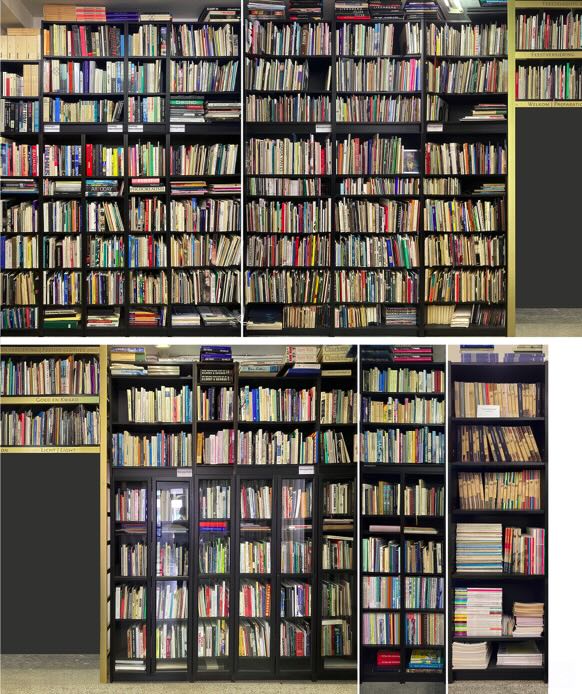
A year ago, after seeing one of Maarten Janssen’s works, Hans invited him to create the final exhibition at Walgenbach Art & Books. The work that initiated this invitation was a painted rack: a coded shelving structure, set upright and painted in several colours. In the traces left by gravity in the wet paint, the sequence of its making remains visible. Behind the rack, prints of books from Janssen’s own library provide both context and a source of inspiration.
For this final exhibition, Janssen has gone through approximately three thousand books in the visual arts department of Walgenbach Art & Books, one by one. He photographed titles that, at some point, had influenced him, whether positively or negatively, through the work itself, the artist, or both. In the exhibition space, this selection forms the context for a number of rack paintings. In the display window, Janssen presents a work made with moving boxes, whose four flaps appear in constantly changing positions, open or closed. The possible combinations form a simple but exhaustive code: xxxx, xxxo, xxox, xoxx, oxxx, xxoo, xoxo, xoox, ooxx, oxox, oxxo, xooo, oxoo, ooxo, ooox, oooo.
For a long time, Maarten Janssen has searched for a method of producing paintings that explain themselves. Without prior knowledge, the viewer should be able to understand why a work has taken the form it has. Concrete Art and Minimal Art, as well as Fundamental Painting, proposed one possible answer by refusing reference to sensory reality. Yet such a refusal can only be maintained by decree: “This grey square must not be seen as part of a concrete wall.” Janssen believed he had found a way beyond this problem by coding the support through materials associated with chance, and by keeping that coding visible. This helped, but it did not explain everything. It left deeper questions unresolved: what drew him to the non-figurative tradition, and where did his psychological fixation on causes originate?
When Janssen began using playing cards alongside dice, spinning tops, coins, and raffle tickets, he encountered richly illustrated tarot decks. These opened a way to bring biographical elements into the structure of a painting, alongside its formal causes. He developed a card system that focuses on the first twenty-five years of life and can function as the support for a painting or drawing. Later motifs and sources of inspiration also return in the works for Art & Books, insofar as they are present within the collection itself.
As May progresses, the retail section of Art & Books becomes increasingly empty. When the exhibition opens at the end of the month, it will already refer to something that is disappearing. The relocation of the books, and the farewell to the premises, are thus given a frame that is melancholic, but hopefully also forceful.