Brutus

Keileweg 10-18, 3029 BS
Thu–Sun 12.00–18.00
Website
Brutus, one of the largest contemporary art institutions in the Netherlands, spans 6,000 square meters in west Rotterdam. Founded in 2008 by Joep van Lieshout, it allows artists complete freedom to express their visions, resulting in bold installations and performances.

4 Jan–8 Mar
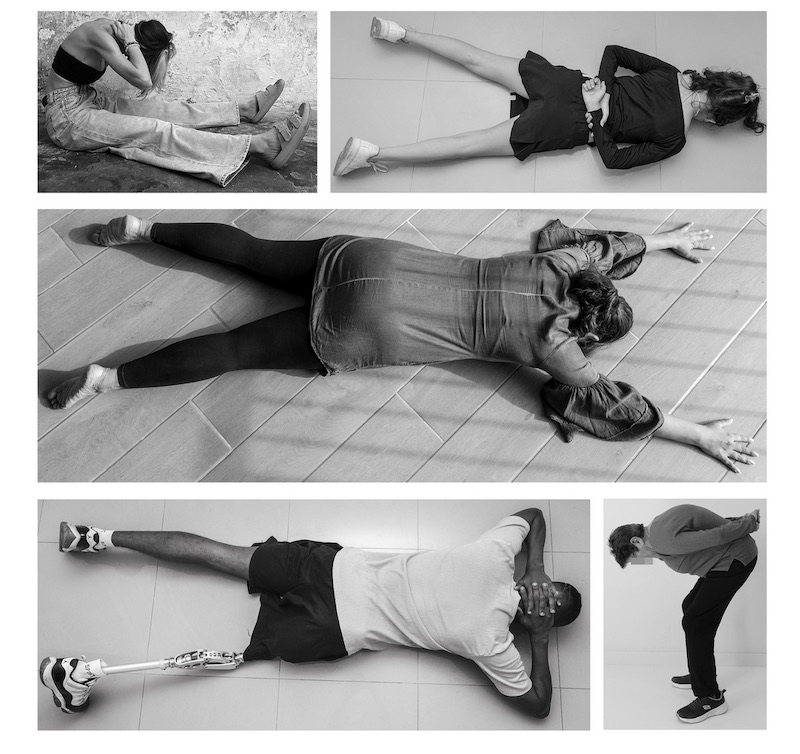
‘The Fear of Falling’ – Carlijn Kingma, solo exhibition

Carlijn Kingma dissects the housing crisis at Brutus: who is pulling the strings?

In collaboration with Thomas Bollen, Martijn Jeroen van der Linden, Sarah van der Giesen, and Jackie Ashkin

4 Jan| Sun| 16.00: Exhibition Opening
27 Feb–8 Mar
‘QISSA – What becomes’ curated by the Rotterdam duo Opperclaes 7 Mar | Sat | 20.00–01.00 – BRUTUS x QISSA – Musuemnacht010 with DJ sets and live acts

An exhibition at the intersection of Art & Design in which they explore how migration, displacement, and cultural fusion affect identity. The exhibition starts from the realization that a “safe haven” is not fixed, but is shaped by movement, transfer, and change. When cultures mix and take on new forms, the way in which identity is experienced and passed on also shifts. What Becomes is part of the QISSA talent program VISUAL STORYTELLERS and showcases the multifaceted work of eight innovative artists, curated by the Rotterdam duo Opperclaes. The result is an exhibition featuring large-scale art installations, digital experiences, performances, and film screenings. Participating artists: Naoko Deriu, Black Childish, Caithlin Courtney Chong, Esra Çöpür, Lorenzo Lennox Schmidt, Tyler Chan, Guanyan Wu, and Rawen Jouini

7 Sat | Sat | 20.00–01.00: BRUTUS x QISSA – Musuemnacht010
25 Mar–14 Jun
AUTONOMOUS, Curated by Ine Gevers

In a world driven by capitalist efficiency, algorithms, data and AI are deployed to reduce human thought to an optimally performing resource. The productive are exploited; those who do not generate value are marginalized. In the relentless pursuit of profit, neurodiversity is therefore quickly framed as a defect. Our upcoming exhibition AUTONOMOUS shifts this perspective. The exhibition presents neurodiverse ways of thinking not as limitations, but as essential forms of resistance and liberation, showing that a society that can think only in terms of efficiency ultimately loses its humanity, while different ways of thinking open the perspectives needed to reshape it. Curated by Ine Gevers, AUTONOMOUS is neurospicy and psychedelic, pushing back against the AI-generated monoculture of the mind. Through large-scale installations, immersive videos and interactive experiences, the exhibition launches a takeover of our computer-controlled, capitalist society. Across three chapters: Cognitive Capitalism, Y'all got ADHD and Psychedelic Pathways, visitors gain access to multiple realities and ways of perceiving the world. More info will follow soon. Curator and Research Following the Brutus exhibition Fake Me Hard (2021), Ine Gevers returns as curator. With over 25 years of experience at the intersection of art, technology and society, Gevers’ research, supported by the Mondriaan Fund, on cognitive capitalism, neurodiversity and psychedelics underpins AUTONOMOUS. Brutus and Gevers share a distinctly inclusive mission: attention for marginalized groups, mixed audiences and deploying art as a driver of social awareness and change. Participating artists and artist collectives HipSick, Stefan Panhans & Andrea Winkler, Oscar Peters, Warren Neidich, Ieva Valule, Levenslust Academie, melanie bonajo, Jennifer Kanary, Shertise Solano, Floris Schönfeld, Charles Stankievech, Andrea Khôra, Antoine Moulinard, Pedro Miguel Matias, Inès Sieulle, Suzanne Treister, Natasha Tontey and Emergence Delft

25 Mar | Wed: Exhibition Opening
ongoing
‘Verwoest Huis’ by Marjan Teeuwen (New (semi) permanent installation) initiated by Marjan Teeuwen and Lobke Broos/ROOF-A

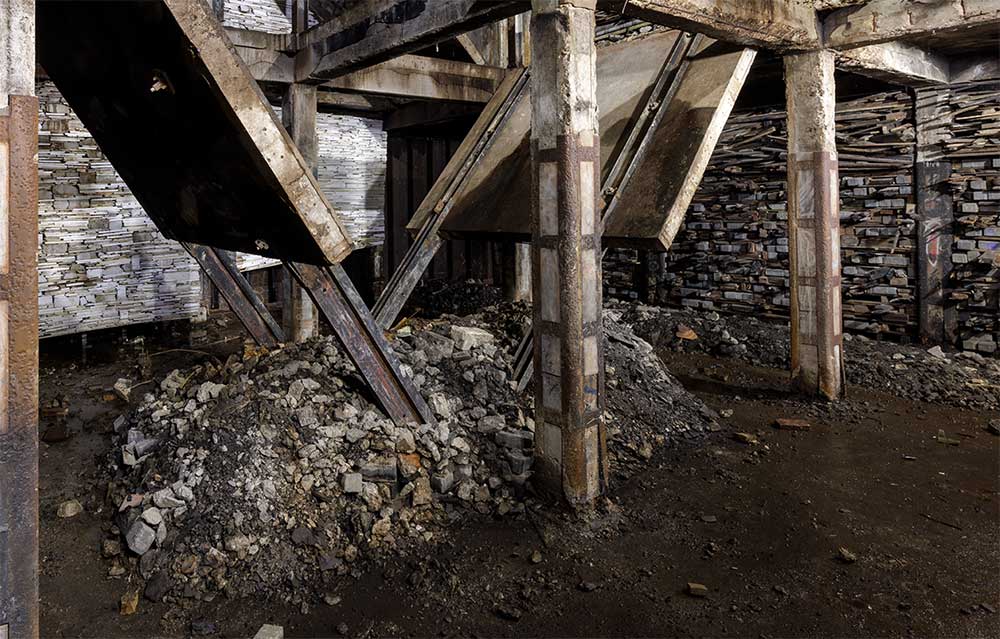
The installation 'Destroyed House' is the result of a challenging plan to create a semi-permanent architectural installation to be realized in one 'undeveloped', once bricked-up space, almost completely cut off from the outside world and without any daylight. In this building, Teeuwen goes on her usual deconstructive way. To finally come to a brutalist installation, in which two uneven squares are trying to get into a more perfect position. Like a phoenix, which attempts to take a geometric form, but only partially and even for a brief moment, succeeds. An abstract minimalist rhythm, in which the feeling of order, regularity and beauty, as well as insecurity, disruption and destruction is sensible (war is not far away).

ongoing (Open by appointment)
'The Engineer’s Bedroom' and 'Disco Inferno' by Atelier Van Lieshout.

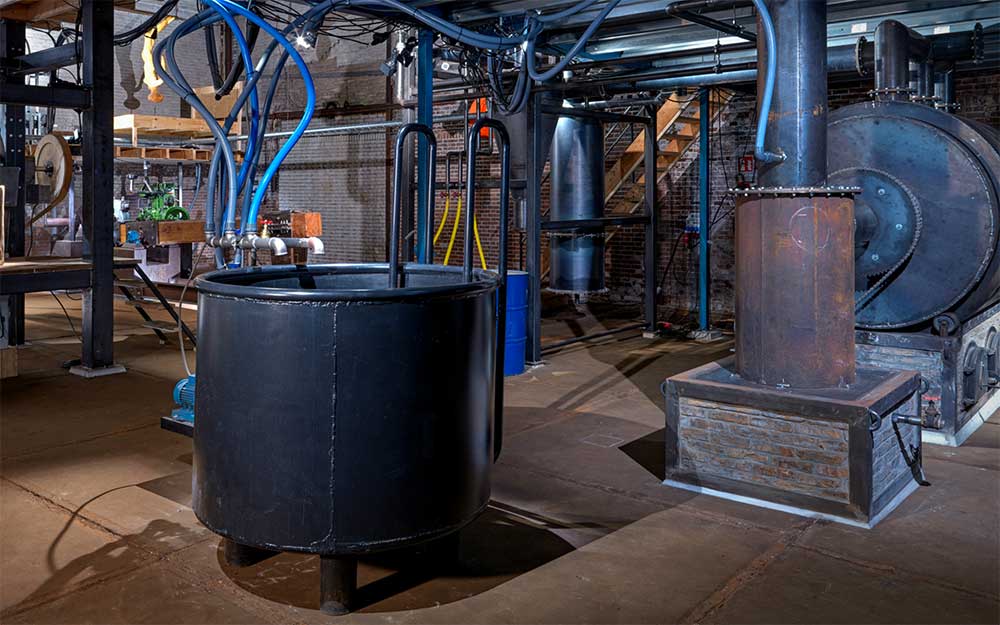
'The Engineer’s Bedroom' and 'Disco Inferno' are an industrial monster with an insatiable appetite for its own products. Forty years of artistic research, experimentation and incessant output inform this Gesamtkunstwerk, which can be read as a self-portrait of Van Lieshout as obsessive system builder, seer, inventor, architect, maker of machine sculptures, engineer and shifter of boundaries. Like all AVL works, ‘Disco Inferno’ is an exercise in self-sufficiency. It is a self-sustaining universe – a labyrinth of countless sculptures, handmade machines, hybrid engines, furniture, other artists’ work, utopias and dystopias – “all stemming from the hammer, the ultimate instrument of change”. The industrial monster is composed of giant, in-house designed and built machines, a spaghetti mash of generators, pumps and shredders, all propelled by a bizarre range of sculpted engines that can run on almost anything (vegetable oil, butter or homemade pyrolysis oil). It is a spectacle of industry and its potential in never-ending motion, yet the work’s only real purpose is to keep going – and to heat the jacuzzi in ‘The Happy End of Everything Spa’. Accompanied by the bubbling and pounding of all these machines, “as long as we have oil or waste plastic, we can keep dancing on the edge of the volcano”. JVL With ‘Disco Inferno’, Van Lieshout continues to sculpt a new material vocabulary. Atelier Van Lieshout gained international recognition for living sculptural installations that function to assert or question independence; inventing objects, structures, machines and thematic bodies of work that annihilate the boundaries between art, architecture and design. In Van Lieshout’s distinctive language, everything is an experiment in what “could be”. AVL’s transgressive practice dissects and invents systems to flirt with power, autarky, politics, fertility, life, sex and death.