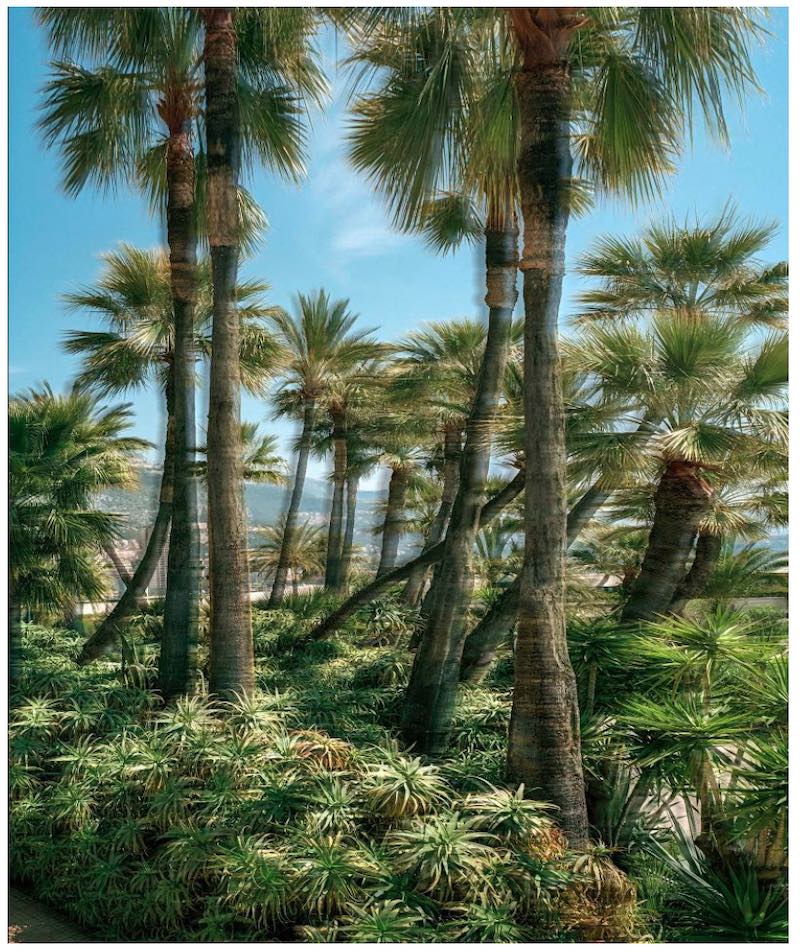
Ralf Brueck studied at the Kunstakademie Düsseldorf, where he began his training with Bernd and Hilla Becher — the legendary photographers who shaped generations of visual artists and whose influence is still felt in the international art world today. He completed his studies as a master student under Thomas Ruff, one of the most influential photographers of his generation and a fixture in the collections of major museums worldwide. That academic training is visible and palpable in Brueck’s work — but he has given it his own unmistakable direction. Where the Bechers documented the industrial landscape with extreme objectivity, and Ruff explored the boundaries of the photographic image through digital manipulation, Brueck goes a step further: he calls photographic reality itself into question. A recurring process is central to his work: the systematic shifting of photographic evidence through mirroring, rotation, and modular recombination. Brueck consistently starts from existing photographic images of architecture and landscape, but subjects them to precise digital processing. Through mirroring, a motif loses its self-evident direction and legibility. Through rotation, the frame of perception shifts. What seemed familiar opens up to something entirely new.
The result is works that cannot be grasped by a fleeting glance. They unfold slowly, layer by layer, and confront the viewer with the question: what is real here, and what is construction? For that is precisely what Brueck demonstrates—that every photographic credibility is a construction, the meaning of which shifts with the viewer's perspective.
Brueck's method is an artistic attitude, a fundamental way of looking at the world and at the medium of photography. Transformation arises when the familiar has already become something else at first glance. The second reality he creates was always already present in the original image: hidden in structure, perspective, and symmetry, but only made visible by his precise intervention.
Brueck's works are held in the collections of the Museum Chemnitz and the Kunstmuseum Ratingen, among others, and are shown at international festivals and in galleries worldwide.